

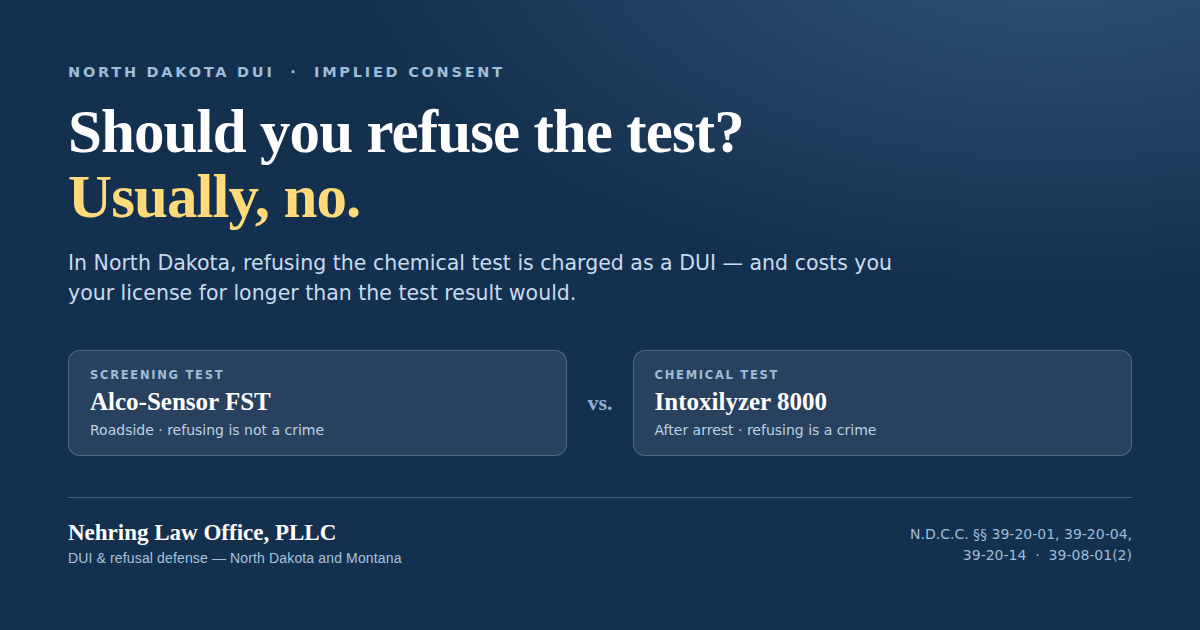
If you are stopped on suspicion of DUI in North Dakota, at some point an officer is going to ask you to blow into something. Most people have heard somewhere that refusing is the smart play — that if the State has no number, the State has no case.
In North Dakota, that advice is usually wrong.
Refusing a chemical test in this state is not a way to avoid a DUI case. Under North Dakota law, refusal is charged and punished under the DUI statute itself, and it carries a license consequence that is longer and harder to work around than the one that comes with a test result. In most first-offense situations, the person who takes the test ends up in a better position than the person who refuses.
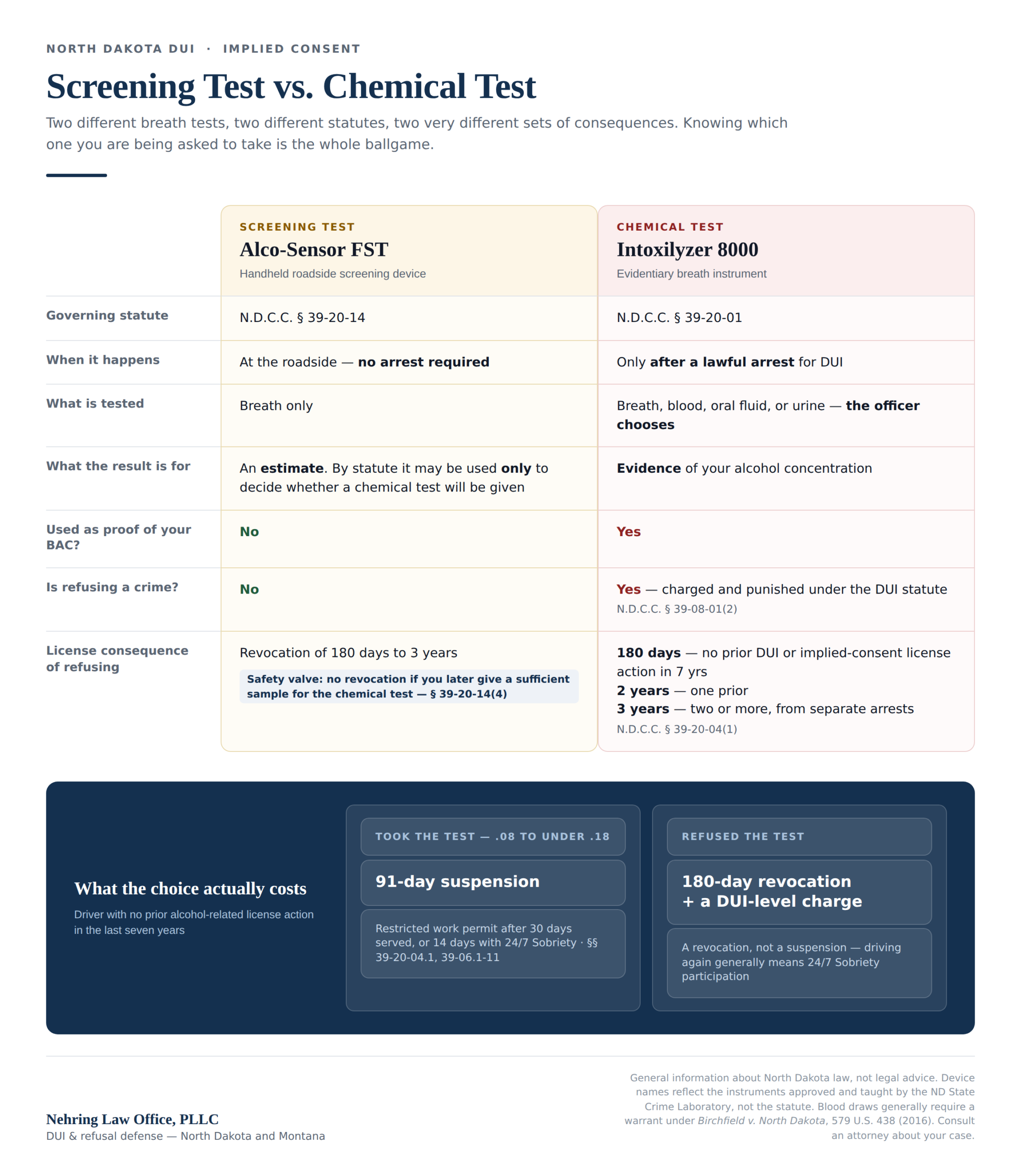
Before getting to why, it is important to understand that there are two completely different tests in a North Dakota DUI stop, governed by two different statutes, with two different sets of consequences. People blur them together constantly, and the difference matters.
Test #1: The Roadside Screening Test (the Alco-Sensor)
The first breath test you are usually offered happens at the roadside, before any arrest. The officer hands you a small handheld unit. North Dakota law does not name a brand — it requires only that screening tests be performed “according to methods and with devices approved by the director of the state crime laboratory” — but in practice the device you will see is the Intoximeters Alco-Sensor FST, the onsite screening device North Dakota officers are certified on through the State Crime Laboratory.
This test is governed by N.D.C.C. § 39-20-14. A few things about it:
- No arrest is required. The officer needs reason to believe you committed a moving traffic violation or a DUI, or were involved in a traffic accident as a driver, plus an observation-based opinion that your body contains alcohol.
- It is a screening tool, not evidence of your BAC. The statute says the screening test is “for the purpose of estimating the alcohol concentration” and that the result “must be used only for determining whether or not a further test shall be given.” That use limitation is why the number on the handheld does not come into court as proof of your alcohol concentration. It exists to give the officer probable cause to arrest.
- Refusing it is not a crime — but it can still cost your license. The officer must advise you that North Dakota law requires the test and that refusal may result in a revocation of at least 180 days and up to three years.
- There is an important safety valve. Under § 39-20-14(4), the Department of Transportation may not revoke your license for refusing the screening test if you go on to provide a sufficient breath, blood, or urine sample for the chemical test in the same incident. In other words, taking the real test at the station cures a roadside refusal.
- But a screening refusal can be used against you. If you refuse the screening test, get arrested for DUI, and then take no chemical test either, your refusal is admissible in court.
Test #2: The Chemical Test (the Intoxilyzer 8000)
This is the real one. After a lawful arrest, you are asked for a chemical test — breath, blood, oral fluid, or urine. For a breath test, North Dakota’s evidentiary instrument is the Intoxilyzer 8000, the instrument the State Crime Laboratory trains and certifies officers on.
This test is governed by N.D.C.C. § 39-20-01:
- It comes only after arrest. The chemical test may be administered “only after placing the individual under arrest” for DUI, and the officer — not you — chooses which test is used.
- The result is evidence. Unlike the screening number, a chemical test result is admissible to prove your alcohol concentration.
- The officer must read you the implied consent advisory — that North Dakota law requires you to take a chemical test and that refusal may result in revocation of your driving privileges for a minimum of 180 days and up to three years. If the officer fails to give that advisory, the refusal is not admissible in the administrative license proceeding.
What Refusing the Chemical Test Actually Costs
Here is where the “no number, no case” theory falls apart.
1. Refusal is charged as a DUI.
Under N.D.C.C. § 39-08-01(2), a driver who refuses a chemical test required under § 39-20-01 “is guilty of an offense under this section” — the DUI statute. That means the same grading and the same minimum penalties: a class B misdemeanor for a first or second offense in seven years, a class A misdemeanor for a third, and a class C felony for a fourth or subsequent offense in fifteen years, with a minimum $500 fine and a mandatory addiction evaluation on a first offense. Refusing does not make the criminal case go away. It creates one.
2. The license hit is longer.
| Driver with no prior alcohol-related license action in 7 years | License consequence |
|---|---|
| Took the test, result .08 to under .18 | 91-day suspension § 39-20-04.1 |
| Refused the chemical test | 180-day revocation § 39-20-04 |
And read the refusal tiers carefully, because this is where people get surprised. The 180-day figure applies only if your record shows no prior suspension, revocation, or denial for a DUI or an implied-consent violation in the preceding seven years. If you have one such prior — including an ordinary test-based DUI suspension — your first refusal is a two-year revocation. With two or more priors arising from at least two separate arrests, it is three years. § 39-20-04(1).
3. A revocation is worse than a suspension, not just longer.
On a first-offense test-based suspension you can generally apply for a restricted work permit after serving 30 days — or after 14 days if you enroll in the 24/7 Sobriety Program. A refusal produces a revocation rather than a suspension, and getting any lawful way to drive during a refusal revocation is a harder problem; as a practical matter it means 24/7 participation. That program is not a formality: it requires twice-daily breath testing seven days a week, or electronic alcohol monitoring, urine testing, or drug patch testing — and by statute the court may not waive the fees.
4. If you hold a CDL, a refusal costs you your commercial privileges.
A disqualification of not less than one year — and not less than three years if it happened while transporting placarded hazardous materials. § 39-06.2-10.
5. Your refusal is evidence.
Proof of refusal is admissible in any civil or criminal action (§ 39-20-08), and prosecutors use it the obvious way: an innocent person takes the test. That argument is available in every refusal case and it is not a weak one.
6. You give up your best defenses.
A test result can be attacked. The Intoxilyzer 8000 is a machine with a maintenance history, a calibration record, a certified operator, an approved method, and a required checklist — and every one of those is a place a case can break. There are records to subpoena and steps to verify. A refusal gives your lawyer none of that. Worse, a refusal permanently removes the possibility of the single best outcome in a DUI case: a number under the legal limit that ends the matter.
Fair Caveats
No honest article says “always take the test,” and this one won’t either.
- If the officer asks for blood and has no search warrant, the analysis is different. Birchfield v. North Dakota, 579 U.S. 438 (2016), held that a breath test may be taken as a search incident to arrest, but that a blood draw generally requires a warrant — and that a State may not make it a crime to refuse a warrantless blood draw. North Dakota’s statute now conditions criminal refusal on an advisory “consistent with the Constitution of the United States and the Constitution of North Dakota.” § 39-08-01(1)(a)(6).
- If your reading would be .18 or above, the test-based suspension for a first offense stretches to 180 days, which narrows the license gap with a refusal revocation.
- Every case has its own facts. The right answer for a person with three prior offenses is not the right answer for a person with none.
Those are conversations to have with a lawyer. But as a general rule, in North Dakota, refusing the chemical test trades a shorter, softer, more defensible case for a longer, harder, less defensible one.
Already Refused? Watch the 25-Day Window
If you have already refused, do not assume the revocation is locked in. North Dakota law allows a driver to “cure” a refusal under N.D.C.C. § 39-20-04(2). In broad terms it requires:
- Mailing the director of the Department of Transportation an affidavit — the Affidavit of Voluntary License Suspension — containing the specific statements the statute requires, including a knowing waiver of your administrative hearing and judicial review;
- Pleading guilty to the underlying DUI or actual physical control charge; and
- Having the court accept that plea, with notice of the acceptance mailed to the director.
All three have to be done within 25 days of the date the officer issued your temporary operator’s permit, and no administrative hearing can have been held. There is also a follow-through step people miss: the director must receive a copy of the final order or judgment of conviction before your privileges come back.
Done correctly and on time, the revocation becomes a suspension under § 39-06.1-10 — 91 days for a first offense. Miss the deadline, or let an administrative hearing go forward first, and the option is gone. Whether curing is available and whether it is the right move depend on your driving record and the strength of your case, so this is worth a call rather than a guess. Twenty-five days is not much time, and the plea has to be accepted by the court inside that window.
What To Do at the Roadside
Be polite, and be brief.
There are things North Dakota does require of you, and you should do them without argument. You have to identify yourself and hand over your paperwork: your name, your driver’s license, proof of insurance, and your registration. (We have written separately about when North Dakota law requires you to identify yourself.) And if the officer asks you to step out of the vehicle, you have to get out — that is a lawful order during a traffic stop. Refusing it creates a brand-new problem instead of solving the one you already have.
What you are not required to do is answer questions. Where are you coming from tonight? Where are you headed? Have you been drinking? How much have you had? None of those are questions you have to answer, and we recommend exercising your right to remain silent on every one of them. You are not going to talk your way out of a DUI investigation, and you cannot un-say an admission once it is on the officer’s bodycam. “I’d rather not answer any questions” is a complete answer. So is saying nothing at all. If you want the longer version of that argument, see why you should think twice before speaking to the police.
Keep that distinction clear in your mind, because it is the whole point of this article: declining to answer questions costs you nothing. Refusing the chemical test is a crime with a license penalty attached. Silence and refusal are not the same decision and should not be treated the same way. Say nothing, and take the chemical test.
And call a lawyer as soon as you can. The clock on your license starts running immediately.
Written by Jeff Nehring
Attorney at Law · Nehring Law Office, PLLC · Williston, North Dakota
Nehring Law Office, PLLC defends DUI and refusal cases in North Dakota and Montana, including administrative license hearings before the North Dakota Department of Transportation. If you have been arrested for DUI or cited for refusal, call our office at (701) 577-5555 to discuss your case.
This article is general information about North Dakota law, not legal advice, and it does not create an attorney-client relationship. Statutes, agency practice, and case law change, and the right course of action depends on the specific facts of your case. Consult an attorney about your situation.